
No products in the cart.

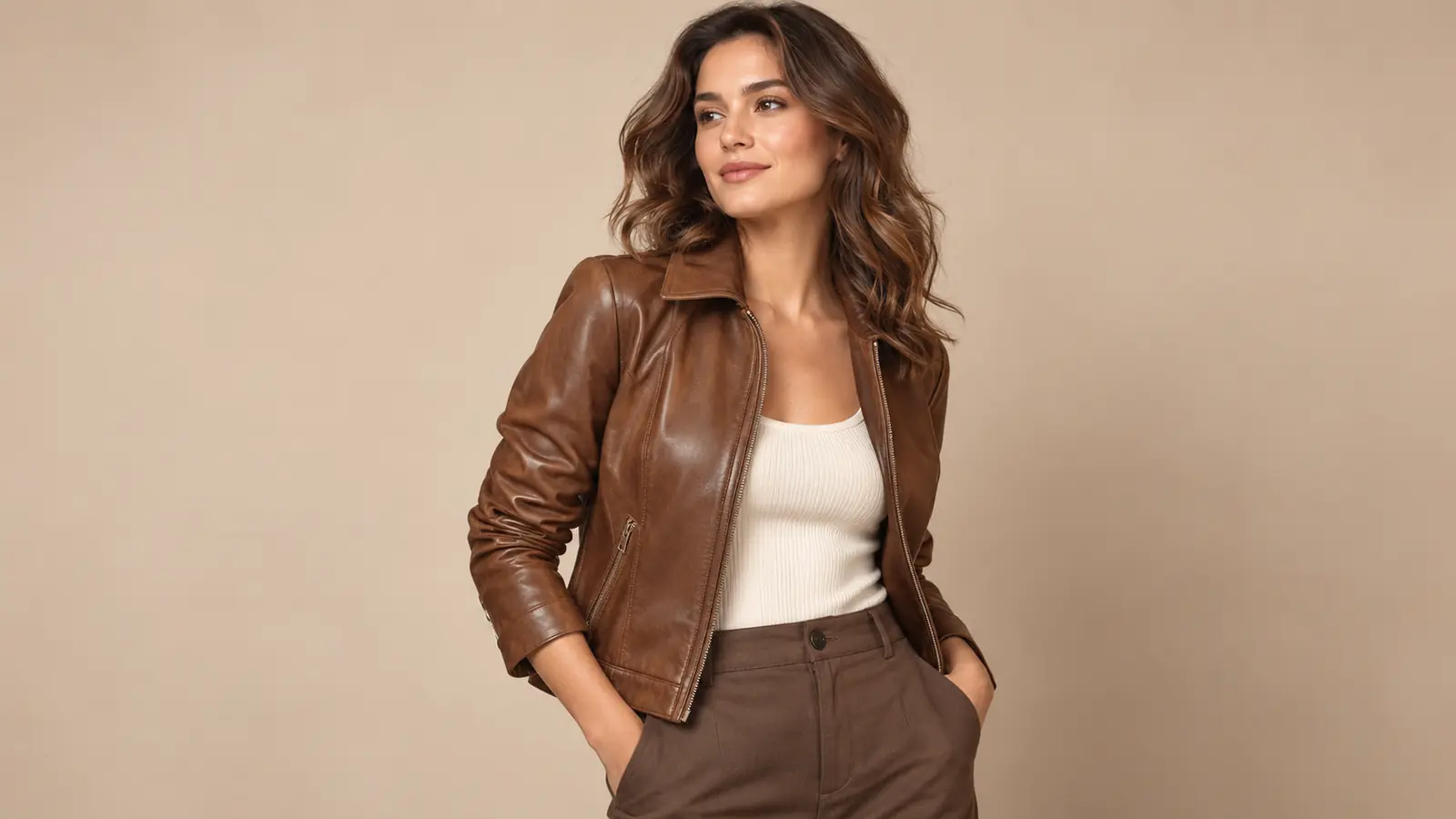
Real vs Faux Brown Leather Jackets for Women: Which Should You Choose?
TL;DR
- Real leather is animal hide; “genuine” confirms leather but does not identify the grain, finish or quality by itself.
- Faux leather is a leather-look material. Its coating, backing and percentages vary, so “PU,” “vegan” or “responsible” is not a complete specification.
- Neither label guarantees better fit, warmth, weather protection, longevity or environmental performance.
- Compare the product page, garment label, care label and seller answers—not just the title.
A practical material-first comparison for choosing the right brown jacket
Direct answer: Choose real leather if you value natural variation, repair potential and the way a hide can change with wear. Choose faux leather if avoiding animal-derived material, a usually lower entry price or a uniform finish matters more. In either case, verify the exact material, backing, coating, care instructions and construction before buying.
Real vs Faux Brown Leather Jackets at a Glance
| Decision factor | Real leather | Faux leather | What to verify |
|---|---|---|---|
| Composition | Animal hide with a finish that varies by product | Leather-look material with a coating and backing that vary | Exact hide/grain or exact coating/backing and percentages |
| Surface | Natural variation may remain visible | Often designed for a more even appearance | Close-up images and finish description |
| Movement | Drape depends on hide, thickness, lining and cut | Drape depends on coating, backing, thickness and cut | Return policy and fit measurements |
| Ageing | May soften or develop patina; finish can also scuff or wear | Coating may crease, scuff, crack or peel; performance varies | Warranty, care guidance and repair options |
| Maintenance | May need leather-specific cleaning and conditioning | Usually does not use hide conditioner; follow coating-specific care | Garment care label |
| Repair | Some scratches, colour loss and panels may be professionally repairable | Coating damage can be harder to restore invisibly | Local specialist assessment |
| Animal origin | Contains animal hide | Generally selected to avoid animal hide, but trims/adhesives may still need checking | Full materials declaration |
What Counts as Real Leather, Faux Leather, PU, Vegan Leather and Bonded Leather?
Material names are useful starting points, not complete specifications. Ask what the surface is, what supports it, and what finish has been applied.
Real leather: Animal hide. Grain layer, split, thickness, tanning and finish can change how it feels and wears.
Faux leather: A man-made leather-look material. The term does not disclose whether the surface is polyurethane, PVC or another system, nor the backing fabric.
PU leather: An ambiguous retail phrase. It may mean a fully synthetic polyurethane-coated material, while “bicast” can refer to split leather with a polyurethane surface. Confirm the construction.
Vegan leather: A non-animal-skin material description, not a chemistry or environmental-performance guarantee. Confirm all components if animal origin matters.
Bonded leather: Leather fibres combined with a binder and finished to resemble leather. It is not the same construction as a solid hide panel.
Labels such as “genuine,” “vegan,” “eco” and “responsible” do not, on their own, tell you the full material recipe, percentage composition or performance. Treat them as prompts for verification.
7 Buying Differences That Matter
1. Appearance and finish
Real hide can show grain, pores and small variations, although heavy coatings or embossed finishes may create a uniform surface. Faux leather can be engineered for consistent colour and texture, including very convincing grain patterns.
Short verdict: Choose by the finish you actually like; do not use visual uniformity alone as proof of material.
2. Feel, drape and movement
A real-leather jacket can feel supple or firm depending on hide, thickness, finish, lining and pattern. Faux leather can also range from soft and fluid to structured. Product measurements and mobility matter more than the material label alone.
Short verdict: Fit-check the shoulders, chest, sleeves and closure with the layers you intend to wear.
3. Ageing, scuffs, cracking and repair
Some real leathers soften and develop patina, while surface finishes can still scratch, fade or crack. Faux coatings can crease, scuff, crack or peel, but timing depends on construction, care, storage and wear. No material label supplies a reliable lifespan by itself.
Short verdict: Real leather often offers more repair routes, but assess the actual finish and damage before promising a repair.
4. Cleaning and conditioning
Real leather may benefit from a cleaner and conditioner approved for its finish. Faux leather usually needs gentle surface cleaning and should not automatically receive hide conditioner. Always test discreetly and follow the garment label.
Short verdict: The correct care method follows the finish—not the colour and not a generic internet recipe.
5. Warmth and breathability
Warmth is influenced by the shell, backing, lining, insulation, openings and fit. Breathability also varies with coatings and construction. “Real” does not automatically mean warm, and “faux” does not automatically mean weatherproof.
Short verdict: Check lining, insulation and intended conditions separately from the material name.
6. Price and value
Faux leather often enters at a lower price, but price also reflects pattern complexity, hardware, lining, scale and brand. Real leather can cost more, yet a higher price still does not prove better fit or construction.
Short verdict: Judge value by verified construction, comfort, care burden, repair options and how often you expect to wear it.
7. Animal origin and environmental considerations
Real leather uses animal hide. Faux leather avoids animal hide in the shell, but the full jacket may contain animal-derived trims or adhesives unless confirmed otherwise. Environmental comparisons require product-specific evidence across raw materials, manufacturing, use, durability and end of life; a single “eco” label is not enough.
Short verdict: Prioritise your animal-origin preference, then ask for a complete bill of materials and evidence behind environmental claims.
Does Real Leather Always Last Longer Than Faux Leather?
Myth: Every real-leather jacket lasts longer than every faux-leather jacket.
Fact: Durability is product-specific. Hide type and finish, coating chemistry, backing, seam design, hardware, fit, wear frequency, storage, climate and care all affect service life. Real leather often has more established restoration options, while widespread delamination of a faux coating can be difficult to reverse. Neither outcome can be predicted from the title alone.
Which Is Easier to Care For?
Faux leather can be straightforward to wipe down, but strong solvents, heat and unsuitable conditioners may damage its coating. Real leather may need more specialised products and periodic conditioning, yet its repair pathway can be broader. Start with the care label and a discreet patch test.
| Care task | Real leather | Faux leather |
|---|---|---|
| Routine clean | Soft dry cloth; finish-approved damp cleaning when needed | Soft damp cloth; avoid saturating backing or seams |
| Conditioning | Only a compatible leather conditioner, after testing | Do not assume hide conditioner is suitable |
| Drying | Air-dry away from direct heat | Air-dry away from direct heat |
| If damaged | Ask a leather specialist about colour, scratch or panel repair | Ask whether coating repair is practical; peeling may not be invisibly reversible |
For a finish-first cleaning sequence, see OvrOne’s brown leather jacket care guide. It explains identification, minimal-moisture cleaning, stain caution and storage without duplicating the full routine here.
How to Verify What a Brown Jacket Is Made Of Before Buying
- Read the materials field and the sewn-in composition label; a product title is not enough.
- For real leather, ask whether the shell is full grain, top grain, corrected grain or split, and what surface finish is used.
- For faux leather, ask for the coating, backing fabric and percentages. “PU leather” alone may be ambiguous.
- Check whether the description, specifications, tags and care instructions agree.
- Ask whether trims, adhesives and linings contain animal-derived material if that matters to you.
- Request close-up images of the surface, edges, seams and reverse side where practical.
- Keep the seller’s written answer and confirm the return or exchange terms before ordering.
Four Active OvrOne Brown Jacket Examples
The women’s brown leather jacket collection currently includes both real and faux listings. The examples below rely only on product-specific fields visible on the active pages; unspecified details remain unknown.
| Style / link | Verified material and listing facts | What remains unverified |
|---|---|---|
| Real classic | Real leather; brown; SKU OVR-004850; polyester lining; front zip; two front pockets plus one inner pocket | Hide species, grain grade, thickness and exact finish |
| Faux classic | Faux leather; brown; SKU OVR-004886; listing mentions recycled/responsible materials and Sugarcane EVA | Full coating/backing composition, percentages, lining, closure and pockets |
| Real moto | Real leather; brown; SKU OVR-004806; polyester lining; biker style; snap-tab collar; zip closure; four listed exterior pockets | Hide species, grain grade, thickness and exact finish |
| Faux moto | Faux leather despite the shorter title; brown; SKU OVR-005457; listing says full composition is not specified | Coating/backing, percentages, lining, closure, pockets, collar and hardware |
Important listing note: The category copy describes the range broadly as genuine leather, but active faux-leather products are present. Use each product’s own material field and ask for clarification when fields conflict.
What OvrOne’s Own Order and Exchange Data Could Clarify
A useful first-party comparison would group only jackets whose material classification is confirmed, use an explicit period and denominator, and separate product, price, channel and construction effects. Return or exchange rates would describe what happened in the records—not prove that material caused the outcome.
| Field | Data |
|---|---|
| Product Category | Leather and Faux Leather Jackets |
| Reporting Period | January–December 2025 |
| Total Orders | 1,200 |
| Real Leather Jacket Orders | 780 |
| Faux Leather Jacket Orders | 420 |
| Real Leather Size Exchanges | 62 |
| Faux Leather Size Exchanges | 48 |
| Real Leather Return Cases | 39 |
| Faux Leather Return Cases | 31 |
| Real Leather Exchange Rate | 62 / 780 = 7.95% |
| Faux Leather Exchange Rate | 48 / 420 = 11.43% |
| Data Source Fields | Order ID, order date, SKU/product ID, material classification, order status, exchange records, return reasons |
| Methodology | Group orders by verified material category and SKU; calculate exchange rates using eligible orders as the denominator; deduplicate cases using order and case IDs |
30-Second Decision Tree
- Is avoiding animal hide your non-negotiable? If yes, choose a verified faux/vegan option and confirm trims, adhesives and lining.
- Do you prefer natural variation and want the possibility of leather restoration? If yes, compare verified real-leather options.
- Is a lower entry price or a very uniform surface the priority? Compare faux options—but verify coating, backing and care.
- Is long service life your priority? Ignore the label shortcut and compare construction, fit, care, repairability and warranty product by product.
- Still undecided? Try both within a clear return policy and choose the jacket that fits, moves and feels right on your body.
Common Misconceptions
- “Genuine leather” means the highest grade. It confirms real leather, but not the precise grain, split or finish.
- All faux leather is polyurethane. Faux materials can use different coatings and backings; verify the composition.
- Vegan automatically means low impact. Animal origin and environmental performance are different questions.
- Real leather never peels. A real-hide base can still have a surface finish that wears, flakes or separates.
- Faux leather is waterproof. A coated surface may resist brief splashes, but seams, backing and construction determine actual water performance.
Frequently Asked Questions
Is faux leather real leather?
No. Faux leather is made to resemble leather but does not use an animal-hide shell. Check the coating, backing and percentages for the actual construction.
Does faux leather peel?
Some faux-leather coatings can peel, crack or delaminate, especially after abrasion, heat, flexing, poor storage or ageing. The label alone cannot predict when or whether this will happen.
Can real leather peel?
The hide itself is not a plastic film, but pigmented or coated finishes on real leather can scuff, crack or flake. Bicast construction also has a polyurethane surface over split leather.
Is PU leather always vegan?
Not necessarily. Retailers may use “PU leather” for fully synthetic coated fabric or for bicast leather, which includes a split-leather base. Confirm both the surface and substrate.
Is faux leather more waterproof?
Do not assume it. A coated surface may shed small splashes, but seams, zippers, backing and coating condition matter. Unless the product has a verified performance claim, treat it as fashion outerwear rather than rainwear.
Which is better for everyday wear?
The better choice is the jacket that meets your material preference, fits through the shoulders and chest, closes comfortably, matches your care tolerance and has construction you can verify. Both real and faux can work for everyday fashion wear.
How do I identify material in an online listing?
Cross-check the product title, material field, description, tags, close-ups and care instructions. Ask for the garment-label composition and a written explanation of ambiguous terms before ordering.
Final Recommendation and Relevant OvrOne Collections
For natural variation and a potentially broader repair path, start with a clearly specified real-leather jacket. For an animal-hide-free shell, a uniform finish or a typically lower entry price, start with a clearly specified faux option. Then compare fit, construction, care, warranty and the exact product fields before deciding.
Browse OvrOne’s real leather jacket collection or faux leather jacket collection, then return to the women’s brown leather jacket collection to compare brown styles. Product-level material details should take priority over broad collection copy.